First in Analog Index , a new series of buyer’s guides for analog photography gear.
If someone says “Nikon L35AF”, they usually mean the 1983 original, the plastic autofocus compact with the five-element lens everyone calls the Pikaichi. It sells for about $255 on eBay. The trouble is that Nikon stretched the name over two later cameras that look nearly the same and sell for 43% and 48% less, and eBay sellers write “Pikaichi” on all three. So you can pay original money for the wrong camera, or leave a good deal alone because the title was vague.
Below: what the original is, how it differs from the other two, and what each one costs.
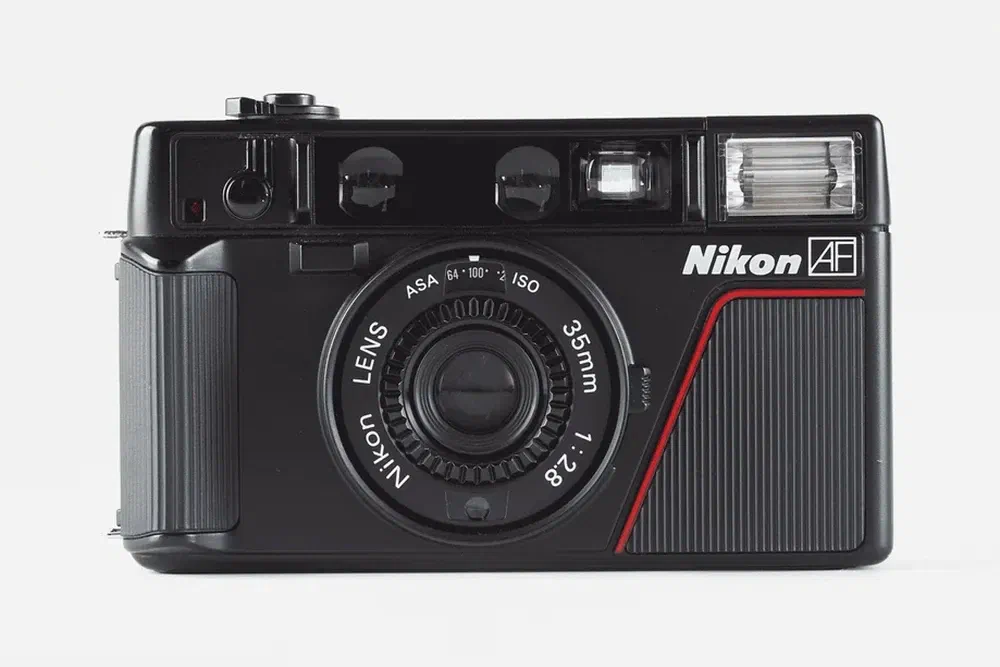
Nikon L35AF vs L35AF2 vs L35AF3: which one is which
| L35AF | L35AF2 (One Touch) | L35AF3 (One Touch AF3) | |
|---|---|---|---|
| Year | 1983 | 1985 | 1987 |
| Lens | 5 elements, 4 groups | 4 elements, 3 groups | 4 elements, 3 groups |
| Film speed | Ring on the lens, tops out at ISO 400 or 1000 | DX coding | DX coding |
| Closest focus | 0.8 m | 0.7 m | 0.45 m |
| Power | 2 x AA | 2 x AA | CR-P2 lithium |
| Flash off | Hold the flash head down | No button | Button |
| Weight | about 345 g | about 320 g | about 280 g |
| Median of the 10 most recent sales | $255 | $145 | $132 |
| Clean sales tracked | 166 | 137 | 22 |
Weights for the first and third are from Nikon’s own manuals. The second is a retailer’s figure; Nikon’s sheet for its date-back twin says about 335 g.
Two traps in listings. “One Touch” is the export name of the second version, but the third version also got sold as One Touch in some places, so a title that says only “One Touch” could be either. The L35AD and L35AD2 are the date-back versions of the first two.
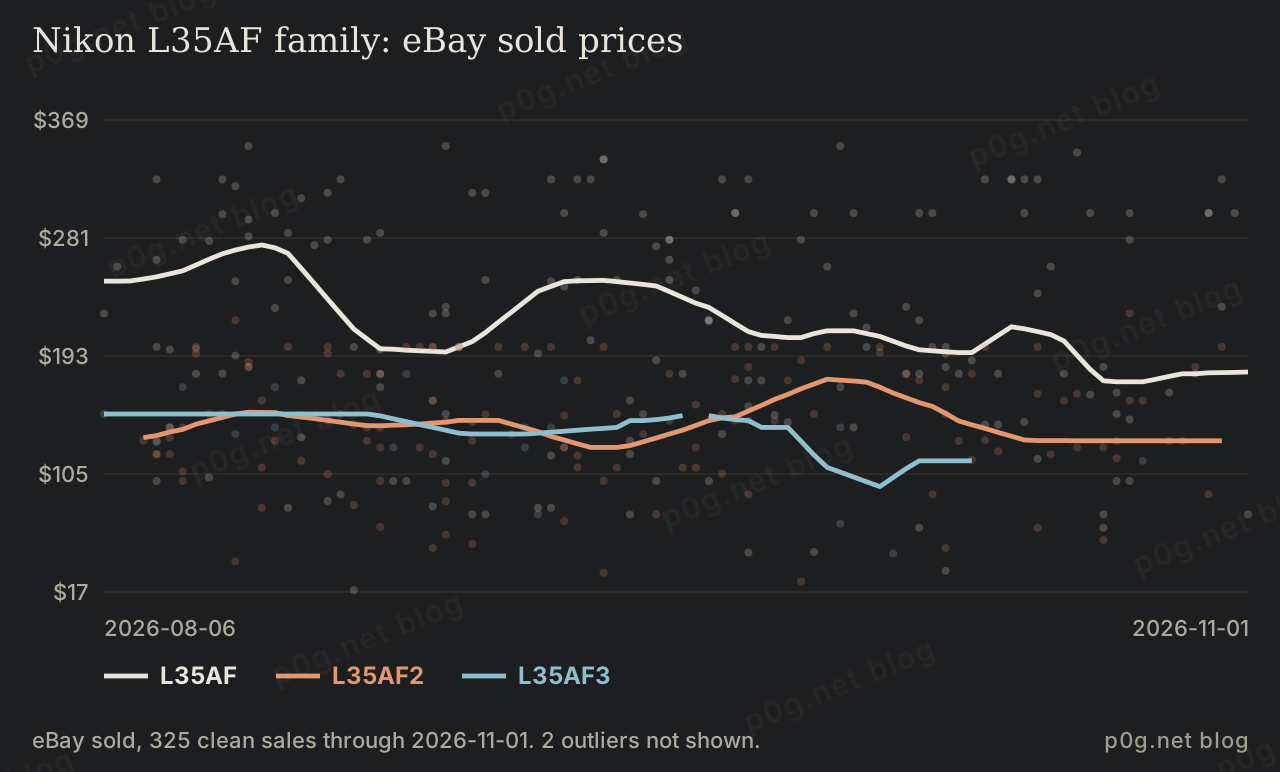
The original sits well above the other two, and that gap is why this guide covers the three versions separately.
How often each one sells
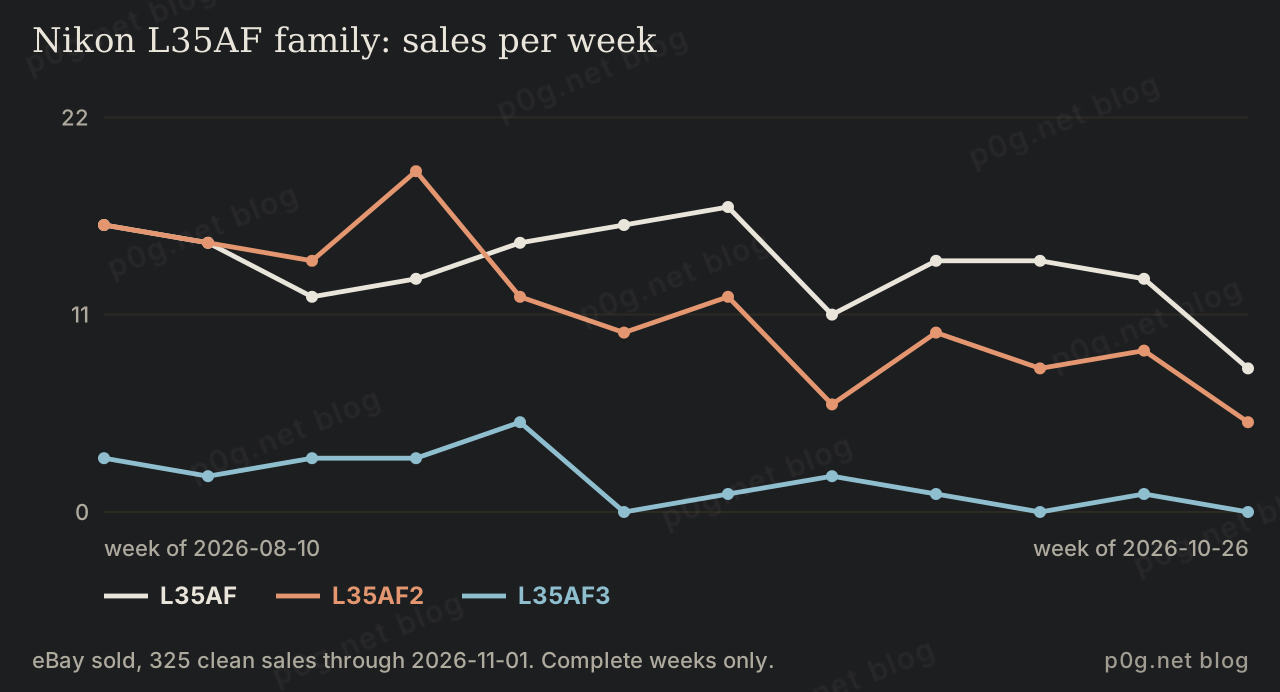
The original sells about 13 times a week on eBay and the L35AF2 about 12. The L35AF3 is the scarce one at about 2 a week, and since searches find fewer of the rarer versions, that figure is a floor.
Nikon L35AF specs (the 1983 original)
Nikon’s first autofocus compact. It is black plastic, fully automatic, with a built-in flash and no manual controls, wrapped around a lens that earned it the nickname. The specs below are from Nikon’s own instruction sheet, not a retailer.
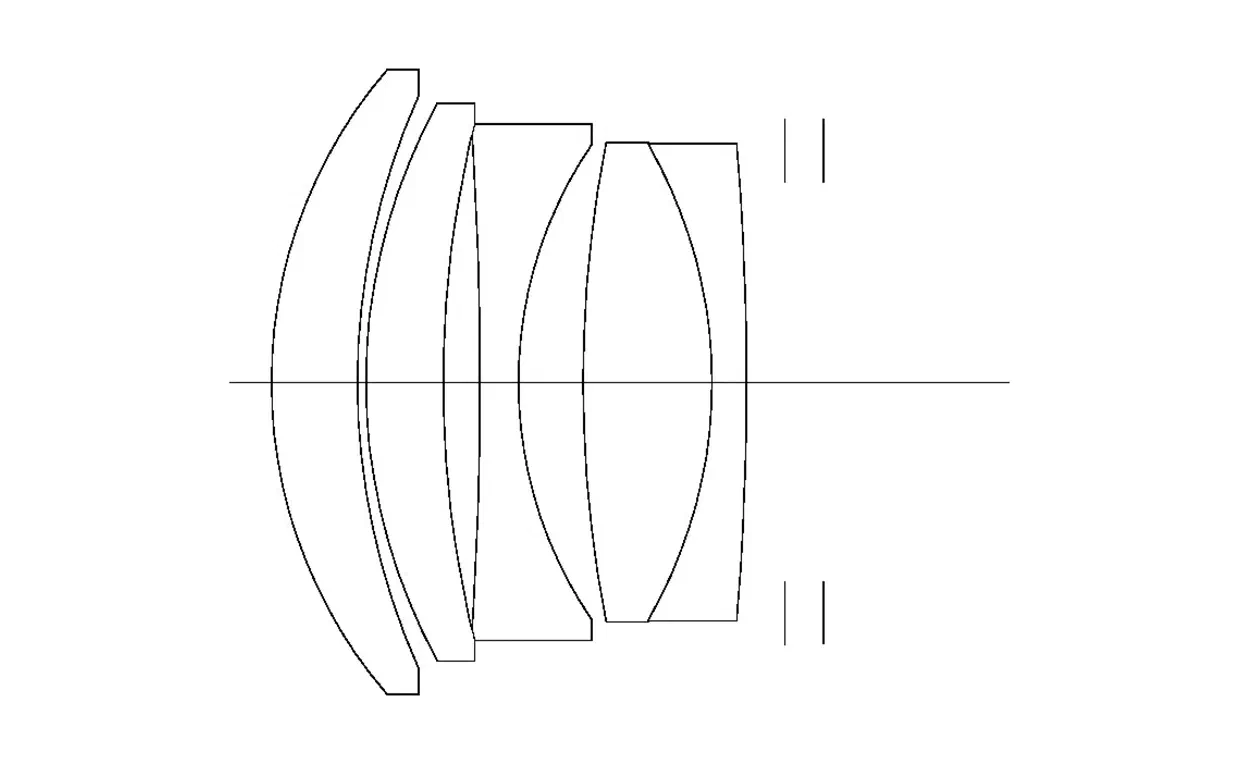
| Lens | Nikon 35mm f/2.8, five elements in four groups, 46 mm filters |
| Focus | Active autofocus, 0.8 m to infinity |
| Exposure | Programmed, EV 6 (f/2.8 at 1/8 s) to EV 17 (f/17.5 at 1/430 s) at ISO 100 |
| Film speed | Set by a ring around the lens, ISO 50 to 1000 (early cameras stop at 400) |
| Shutter | Programmed electronic leaf shutter that also works as the diaphragm |
| Flash | Pop-up, guide number 10 (ISO 100, metres), about 7 seconds to recharge |
| Power | Two AA alkaline cells (Nikon says no NiCd) |
| Size | 124 x 73 x 45.5 mm, about 345 g without batteries |
Two versions of the original: ISO 400 and ISO 1000
The original came with two film-speed ranges. Early cameras have an ISO ring that tops out at ISO 400, and later ones go up to ISO 1000, according to camera-wiki.org and retailers who have sold both. Nikon’s instruction sheet describes the ISO 50 to 1000 version.
The 1000 version is the more desirable one because it handles fast film. If you shoot ISO 400 or slower, which covers most color negative and black-and-white film, the difference does not matter and either one is fine. If you like ISO 800 film, look for the 1000 version. To tell which you are buying, ask the seller what the ring tops out at, or look at the ring in the photos.
The Nikon L35AF lens
Nikon’s own history dates the autofocus compact boom to 1977, when Konica’s compact made focusing something amateurs no longer had to learn. Rivals followed, and Nikon pulled people off its SLR design team to start building compacts. Six years later came the L35AF. Nikon points out that most rival compacts of the day used a 38mm lens, and this one got a real 35mm wide-angle.
The design was finished in December 1981 by Koichi Wakamiya, and it is a Sonnar-type layout where most compacts used a Tessar-type. The lens is engraved “Nikon LENS 35mm 1:2.8” with no Nikkor name, which started rumours that another company designed it. Nikon’s own history article says it designed the lens in house, on the same thinking as its Nikkors.
Two sample photographs from the lens, both on ISO 64 film with automatic exposure at apertures between f/5.6 and f/8. In the first, look at the resolution and contrast in Mt. Fuji and the forest in the foreground. In the second, look at the wood grain and the skin texture.
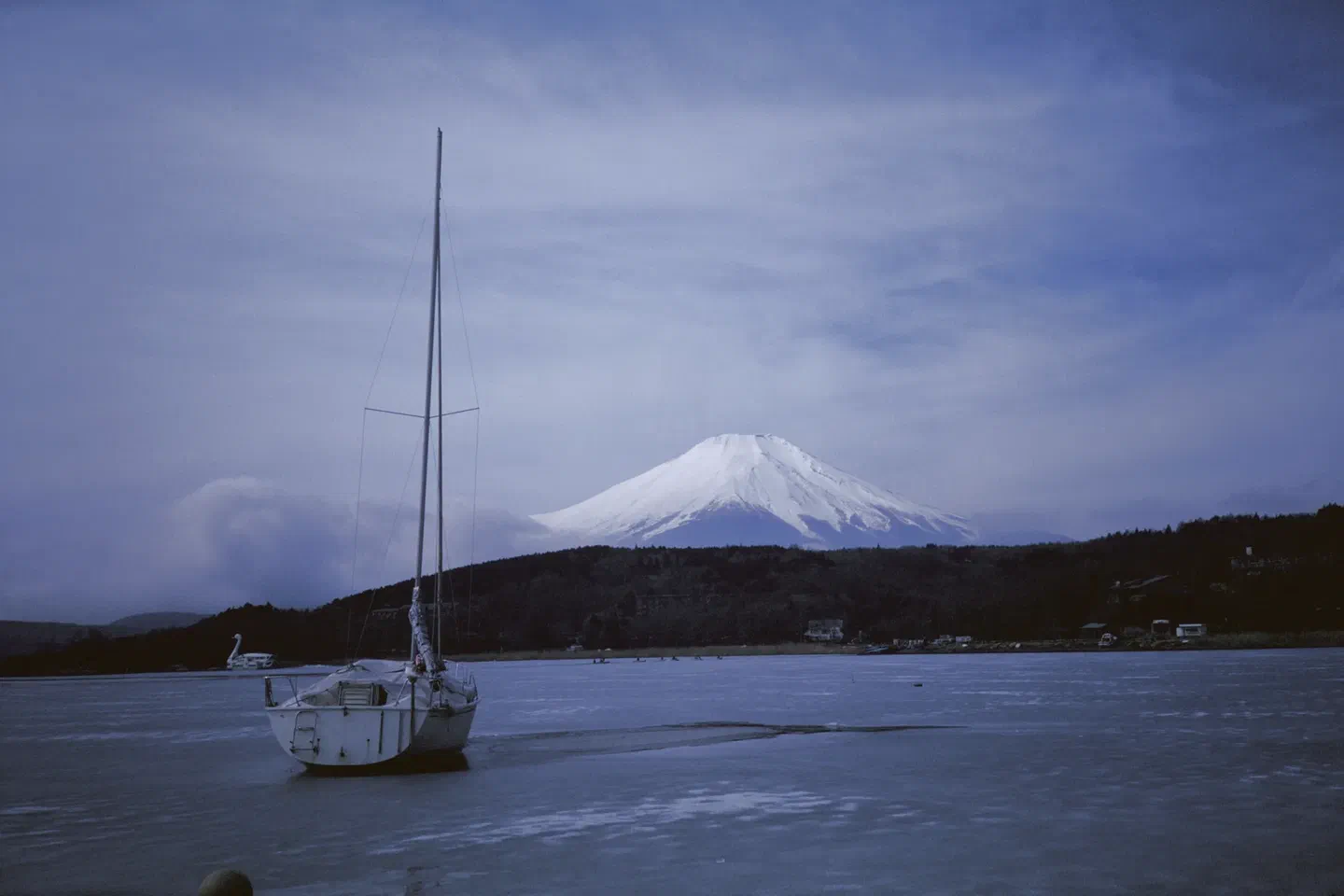
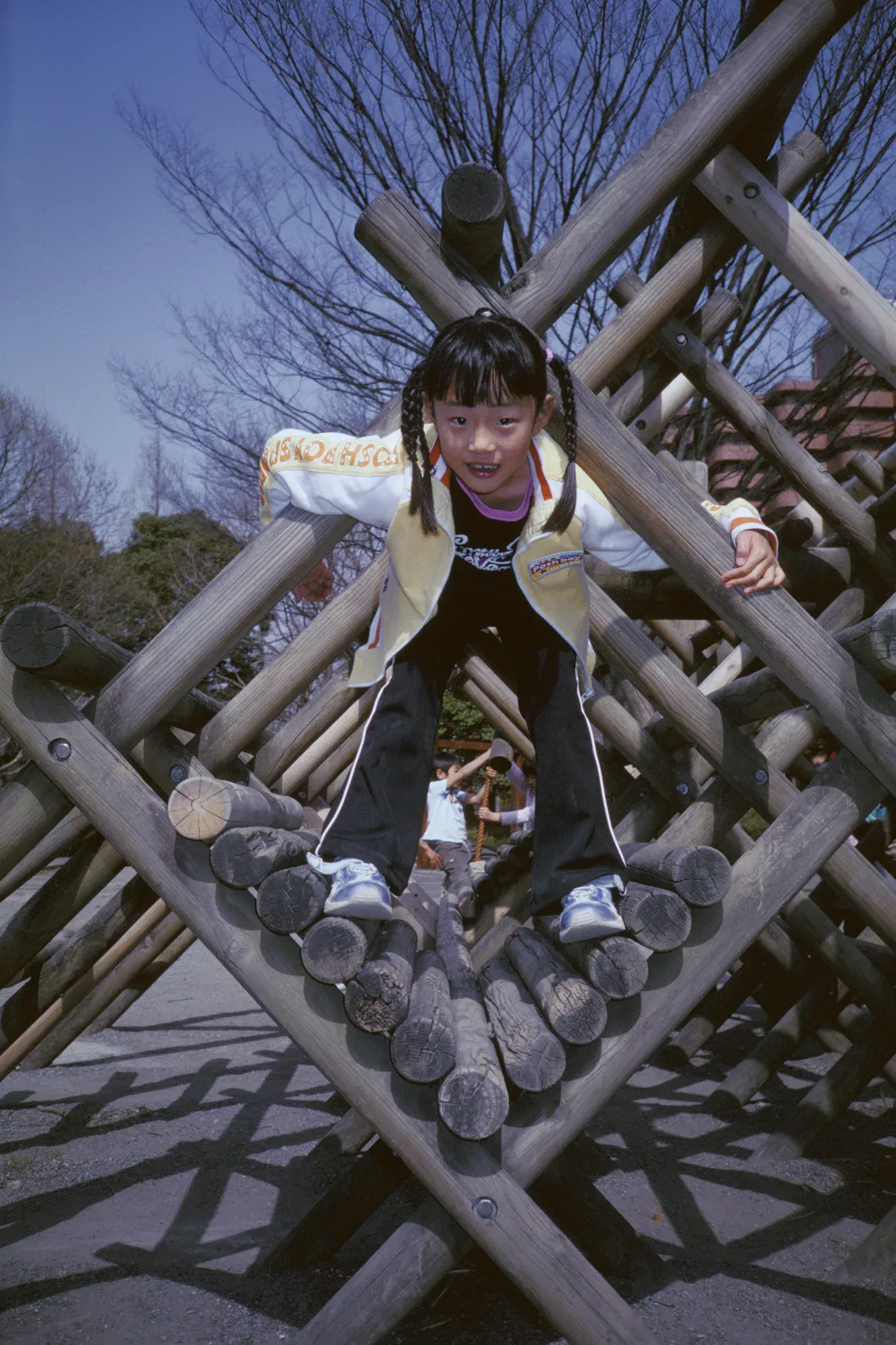
Nikon’s own verdict is modest: about 2 percent pincushion distortion, “suppressed to a relatively reasonable degree”, and edge illumination slightly low wide open. One 35mmc reviewer found strong vignetting at f/2.8, high contrast, and sharpness that holds into the corners. Nikon’s history article gives no element count. The five elements in four groups come from Nikon’s instruction sheet, and camera-wiki.org and retailers agree.
Using the Nikon L35AF
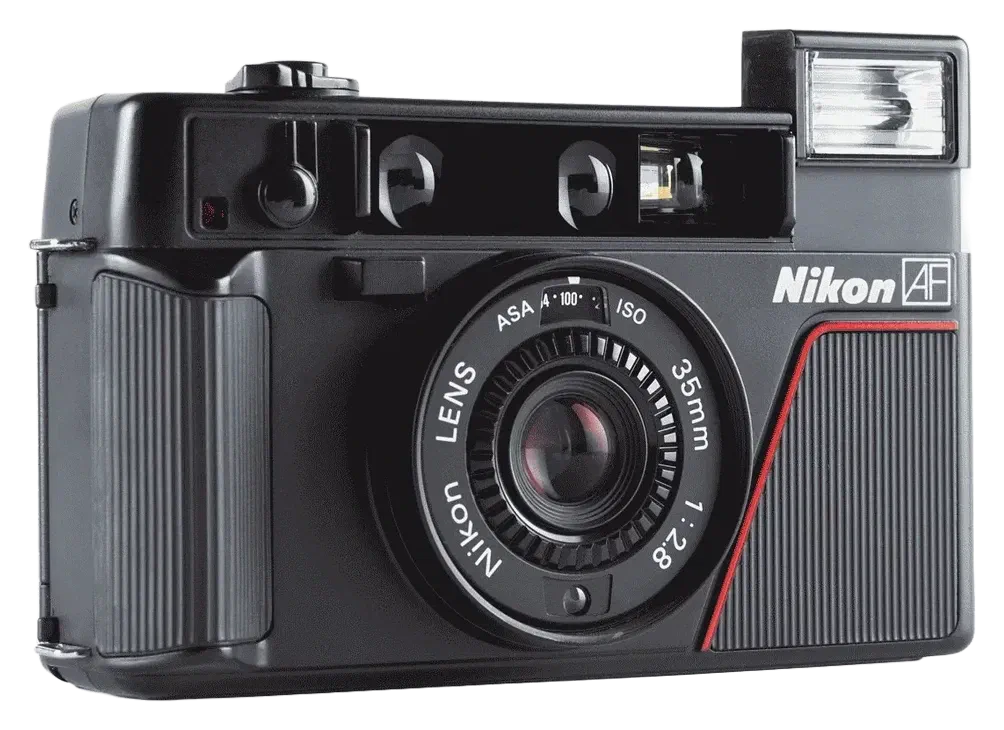
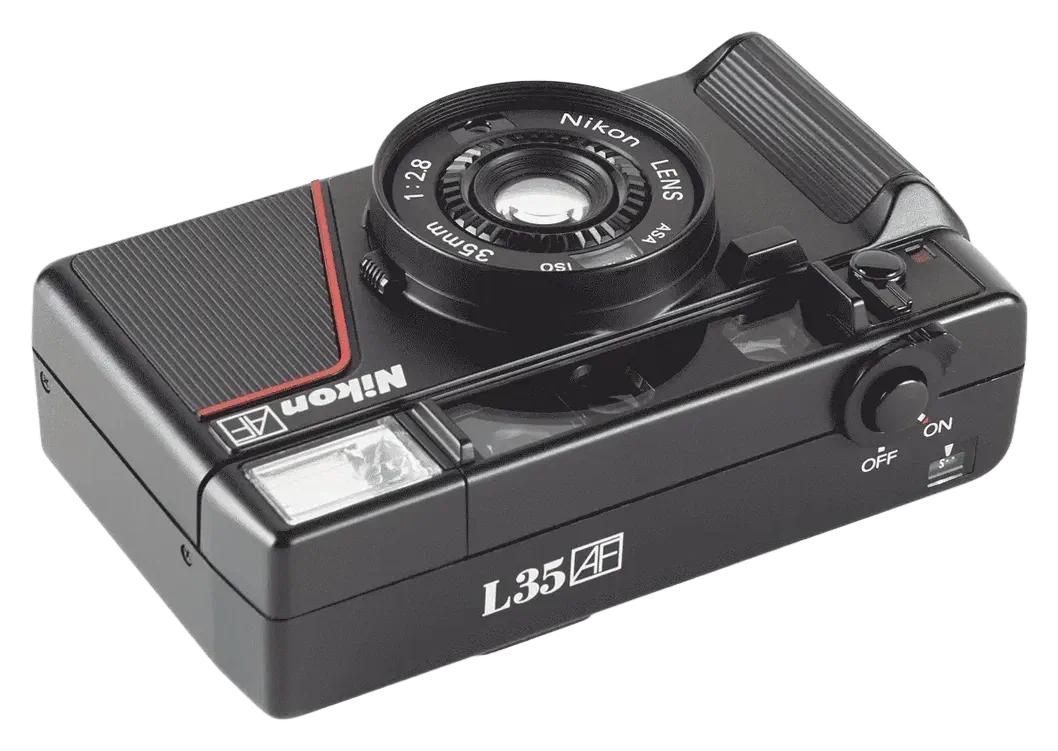
The shutter button has a long throw because it runs metering, autofocus, and the viewfinder distance readout before it fires. That is by design. Film advance waits until you let go of the button. A needle in the viewfinder shows focus distance over four icons, and there is a self-timer switch and a backlight lever around the lens that adds about +2 EV while you hold it.
The flash is the annoying part. It pops up by itself in low light and there is no off switch. To stop it you push the head down by hand.
Common Nikon L35AF problems
The two biggest problems are a stuck shutter and the battery door. Test that the shutter fires and closes cleanly.
The battery door is a known weak spot. It is made of a different plastic from the rest of the camera, it tends to open on its own, and replacements are not around, which is why so many of these cameras have a piece of tape over it. A taped door is normal and tape is a good fix, so do not mark a camera down for it. Do check that the door is there and not cracked or broken.
As with any old electronics, check that the battery contacts are in good condition. If batteries were left in the camera they may have leaked, and corroded contacts are a common reason a camera is dead. Clean contacts mean a good start; crusty ones mean a project.
Beyond that, what follows is owner reports, not data. The most common is a camera that refuses to advance film, or winds the whole roll at once. It is often cured by reseating the batteries or cleaning the battery contacts, and people have revived dead cameras that way. One 35mmc reviewer’s copy failed to fire about 60 percent of the time even on fresh batteries, and another reader had the focus needle stuck at infinity, which others blame on a dirty focus sensor or weak batteries. Repair write-ups exist on Learn Camera Repair and from Richard Haw.
The split matters when you are buying or fixing. Battery faults are cheap to cure with fresh cells and clean contacts. A stuck shutter is not, which is why it is the one to rule out before you pay.
So before you pay, ask whether it advances and fires on fresh batteries, ask for a photo of the battery compartment, contacts, and door, and ask whether the lens cap is included. The long shutter throw is normal. A camera that does nothing on fresh batteries is not.
Nikon L35AF price on eBay
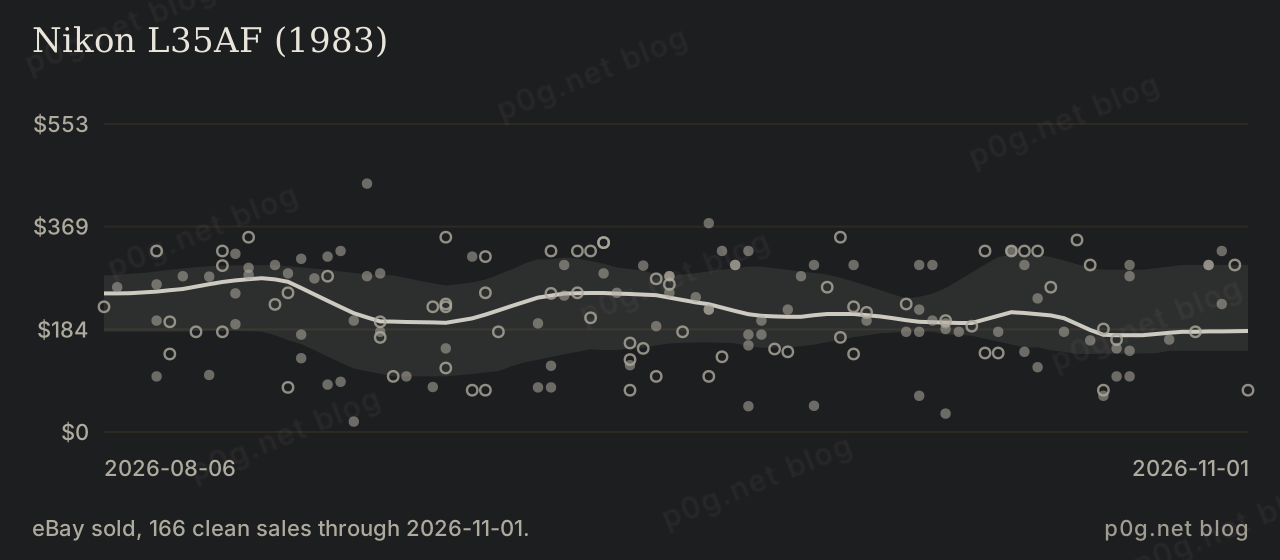
There are 166 clean sold listings for the original from August 6 to November 1, 2026. The median of the ten most recent sales was $254.94 at the last check (November 1, 2026), the median of all of them is $220, and the range runs from $18 to $446. 70 of those are best-offer listings, where eBay shows the asking price and not what the buyer paid.
Most of that spread is condition. In sales through November 1, serviced “Pikaichi” cameras sold for $280 to $325 and plain working ones for $100 to $230. For scale, Brooklyn Film Camera lists a refurbished one with a three-month warranty at $625. That is an asking price, not a sale.
L35AF2 / One Touch (1985)
The second version added DX film-speed coding, and the big change is the lens: four elements instead of five. Sellers call it “L35AF2”, “One Touch” or “One Touch L35AF2” interchangeably. The L35AD2 is the same camera with a date back, and the One Touch is the AF2 without the data back, sold under that name for export from Japan.
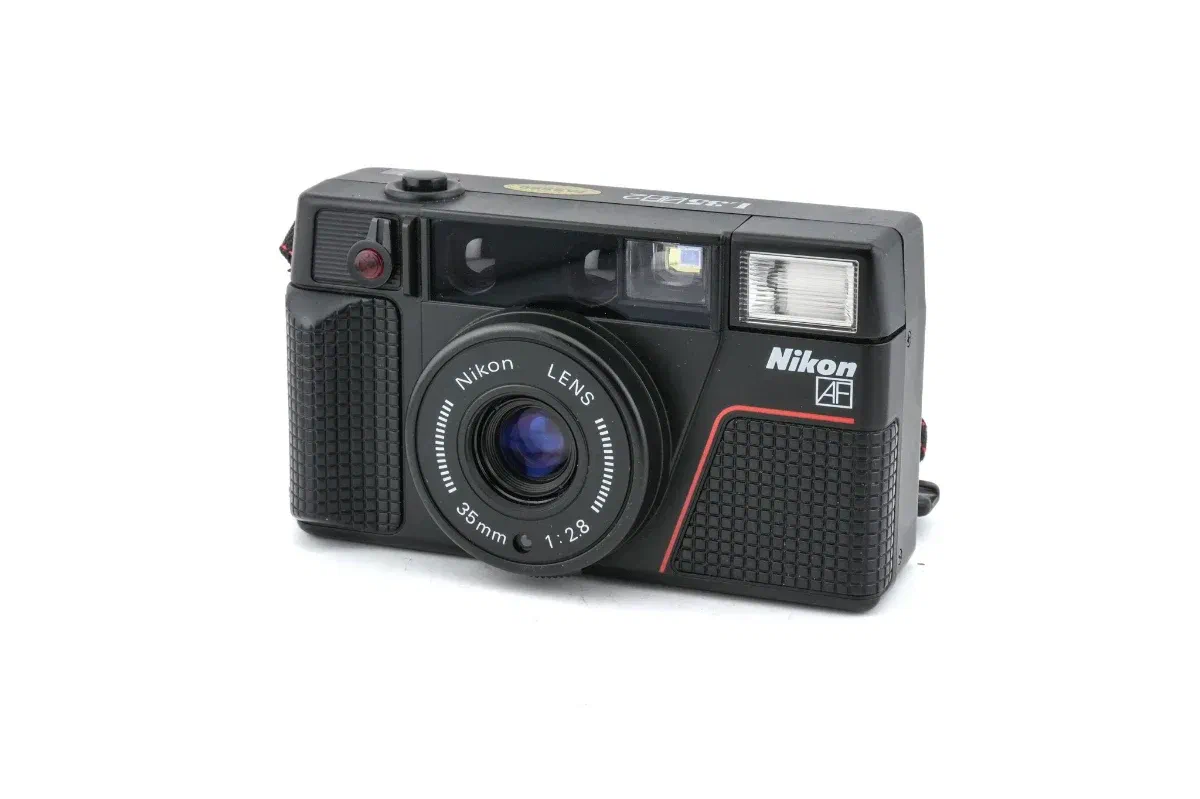
- Lens: Nikon 35mm f/2.8, four elements in three groups.
- Focus: 0.7 m minimum.
- Film speed: DX coded. Nikon’s sheet for the date-back model says ISO 50 to 1600. A retailer says 50 to 1000 for the plain AF2 and a review says 60 to 1600, so there is no single answer.
- Power: AA cells. The date back adds a coin cell; Analog.Cafe says CR2032 and Nikon’s own sheet says CR2025.
- It debuted in the mid-1980s at about $210, according to Analog.Cafe.
Against the original: a four-element lens in place of five, DX film-speed reading so there is no ISO ring to set, and slightly closer focus. Against the third: focus stops at 0.7 m instead of 0.45 m, there is no flash-off button, and it takes AA cells instead of a lithium.
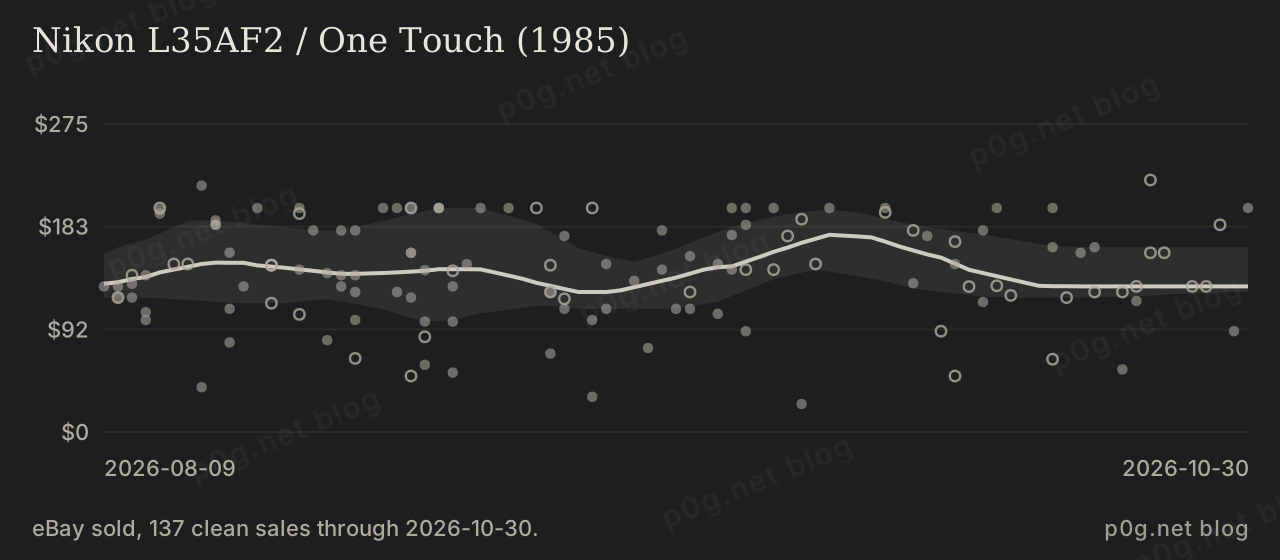
From 137 clean sales over August 9 to October 30, 2026, the median of the ten most recent is $144.98 and the median of all of them is $145. The range is $25 to $225, and 45 are best-offer listings. That is 43% under the original.
L35AF3 / One Touch AF3 (1987)
This one keeps the four-element lens but focuses much closer, and adds a flash-off button and a lithium battery. Like the second, it has DX coding and a built-in lens cover. It was sold as the One Touch in some territories, which is where the listing confusion comes from. Nikon calls the automatic backlight compensation on the flash Smart Flash, and a Flash Dimmer covers the flash for close subjects.
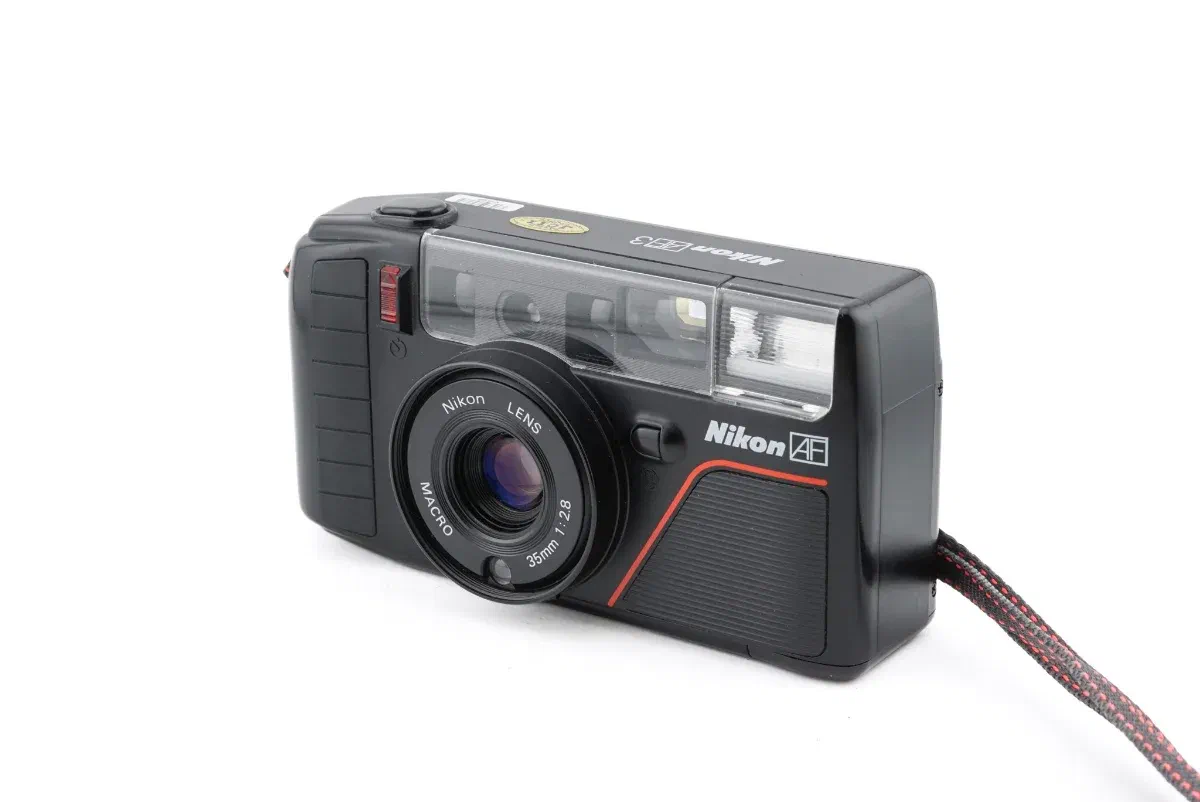
- Lens: Nikon 35mm f/2.8, four elements in three groups, 46 mm filters.
- Focus: 0.45 m (1.5 ft) minimum, per Nikon’s manual. Nikon’s US dealer catalogue rounds it to 0.5 m.
- Film speed: automatic from the DX code, ISO 64 to 1600. Film without a DX code is set to ISO 100.
- Flash: recharges in about 2 seconds, with a flash-off button.
- Power: one 6 V lithium pack, Duracell DL223A or Panasonic BR-P2.
- Size: 135.8 x 71.5 x 48 mm and about 280 g without the battery.
A retailer lists it at 135 x 74 x 49 mm and 282 g. Close, but Nikon’s manual is the better source.
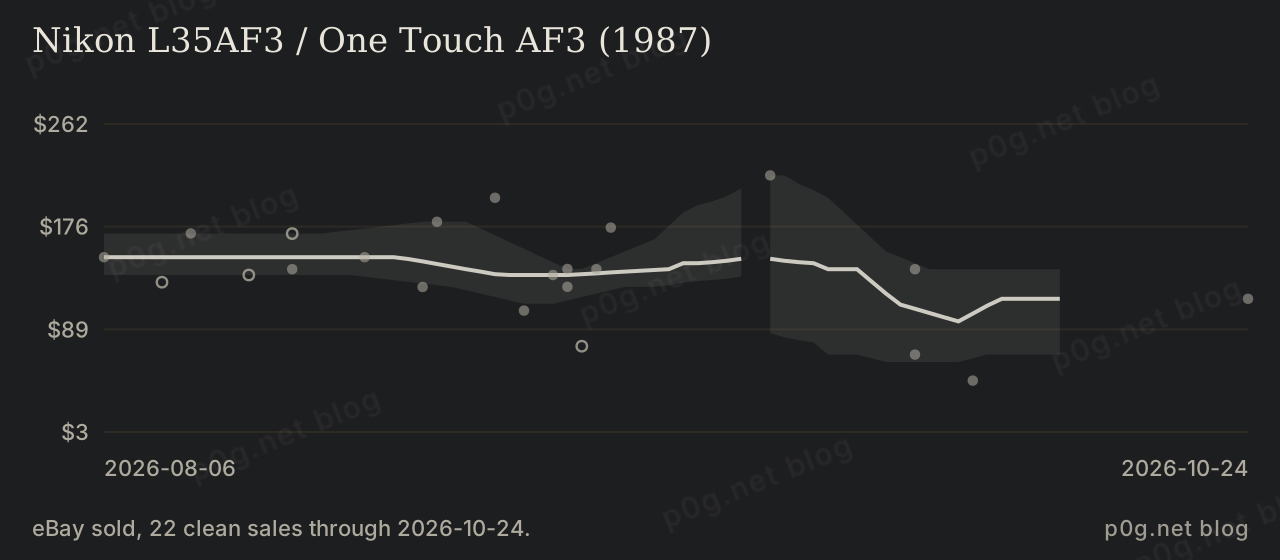
This is the thinnest data in the family, 22 clean sales over August 6 to October 24, 2026. The median of the ten most recent is $132.49, the median of all of them is $140, and the range is $46 to $219. With a sample that small, one expensive sale moves the median, so treat it as soft.
Are the L35AF2 and L35AF3 lenses as sharp?
Both later cameras use a four-element lens in place of the original’s five. In use, both are reported as sharp. The L35AF3 reviewer shot a roll of Ilford XP2 and found every frame in focus and the images sharp and well exposed, with some harsh contrast attributed to the film. A review of the L35AF2 says that when everything is in focus it looks great, and that the basic autofocus can be fooled by shallow depth of field, people and small subjects.
What is not on record is a controlled side-by-side with the five-element lens in the original. The original has the reputation and the owner reports of strong resolution into the corners. The later two are good lenses in good cameras, with DX film-speed reading, closer focus and, on the third, a flash-off button. The original is the one with the name.
Nikon L35AF lens cap and filters
Only the original has a separate lens cap. Nikon’s manual has you switch the camera off with the ON/OFF switch, cover the lens with the cap, and tie a string through the hole in the cap to the neck strap so the cap does not get lost. The L35AF2 and L35AF3 have a sliding lens cover built in, so they need no cap.
The original and the L35AF3 take 46 mm filters, and 46 mm is the size to search for. The L35AF2 has no filter thread: a review of the L35AF3 says it brought the 46 mm thread back, and the L35AF2’s built-in cover takes the place of a cap. Nikon sold a UV filter for the original, the L37, which also protects the front of the lens.
A standard 46 mm center-pinch cap fits the original, and one is the easy fix when the original cap is missing:
- K&F Concept 46 mm lens cap, 4-in-1 center pinch for the original L35AF
- Tiffen 46 mm UV protector filter for the original or the L35AF3
Reading a listing
- “Pikaichi” in the title tells you nothing. Sellers put it on every version.
- “One Touch” alone could be the second or third version.
- An ISO ring around the lens means the original, and the ring tops out at either 400 or 1000. DX coding means the second or third.
- A flash-off button means the third. A sliding lens cover means the second or third.
- A lithium CR-P2 battery means the third. Two AAs mean the first or second.
- Closest focus is 0.8 m, 0.7 m and 0.45 m, in version order. Ask the seller if the listing does not say.
Which Nikon L35AF should you buy?
If you want the lens people talk about, the original is the one, and condition sets the price: a plain working one is $100 to $230 in the data and a serviced one is $280 to $325. If you want a cheap, simple point-and-shoot and do not care about the nickname, the second and third versions are the bargains, and the third gets you closer focus and a flash you can turn off for about the same money as the second. Whichever you want, find out which version a “One Touch” listing really is before you pay, because the second and third sell for less than the original.
Nikon L35AF FAQ
What is the difference between the Nikon L35AF, L35AF2, and L35AF3?
The 1983 L35AF has a five-element lens and an ISO ring around it. The 1985 L35AF2 (One Touch) and the 1987 L35AF3 (One Touch AF3) have four-element lenses and read film speed from the DX code. The L35AF3 also focuses down to 0.45 m and has a flash-off button.
How much is a Nikon L35AF worth?
About $255 is the median of the ten most recent eBay sales of the original, and $220 is the median of all 166 tracked sales. Condition explains the gap, and the price section has the breakdown. The L35AF2 and L35AF3 sell for about 43% and 48% less than the recent figure.
What size lens cap does the Nikon L35AF take?
The original takes 46 mm filters, and a standard 46 mm center-pinch cap fits it. The L35AF2 and L35AF3 have a built-in sliding lens cover.
Why won’t my Nikon L35AF fire or advance film?
Start with the batteries. Reseat two fresh AA alkaline cells (Nikon says no NiCd) and scrub both battery contacts, since leaked batteries leave corrosion. That cures many cameras that will not fire, will not advance, or wind the whole roll at once.
Then check two simple things. The battery door tends to open on its own, which can let the batteries lose contact. And if the flash has popped up, the shutter stays locked until it has charged, which takes about 7 seconds. Film advance also waits until you let go of the shutter button.
If it still does nothing on fresh batteries with clean contacts, suspect a stuck shutter. That one needs a repair, not a cleaning.
What does Pikaichi mean?
It is Nikon’s nickname for the original L35AF, roughly “top notch.” Sellers now put it on all three versions, so it does not tell you which one you are buying.
Nikon L35AF manual and other documents
Every spec above marked as Nikon’s comes from these.
- Nikon L35AF instruction sheet (PDF, 20 pages, English and Spanish). Pages 2 and 3 are Nikon’s spec sheet for the L35AD2, the date-back version of the second camera.
- Nikon One-Touch instruction manual (PDF, English and Spanish) for the third version.
- Nikon USA dealer catalogue page (PDF, one page) for the third version, product number 1805, catalogue page 11.
- Nikon’s history article on the lens , the best account of why the original is the one people want.