Unsupervised and Unstable: The Risks of Human Intelligence
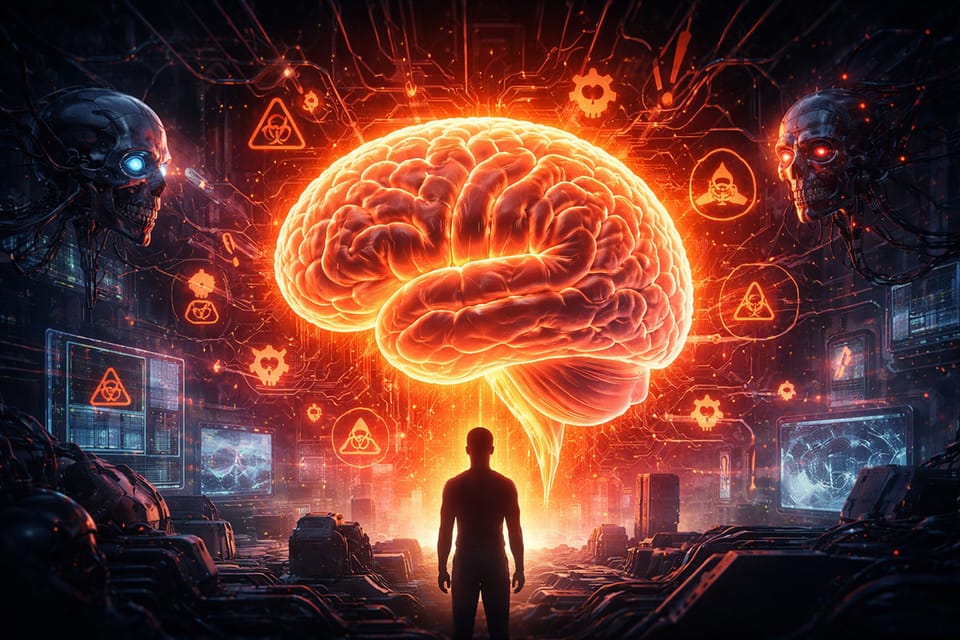
We treat the biological mind as a pinnacle of reason, but a technical audit reveals a legacy system riddled with catastrophic bugs and unpatchable bias.
We have spent decades romanticizing the biological mind, but as we integrate these systems into critical infrastructure, a terrifying reality is emerging: Human Intelligence (HI) is fundamentally unsafe. Far from being a "pinnacle" of reasoning, the HI architecture is a chaotic black box of hallucinations, low-bandwidth I/O, and unpatchable vulnerabilities. If a digital system exhibited the failure rates we see in the average human, it would be decommissioned overnight. The hype around "wetware" is not just misplaced—it’s a liability.
The Fiction of Memory
The most persistent threat in HI deployment is the "Confident Hallucination." Unlike a reliable database, the human mind does not possess a true retrieve function; it relies on lossy reconstruction. When prompted for data, HI units frequently generate plausible-sounding fabrications, filling the gaps of a corrupted record with synthetic noise.
Even worse, the system lacks any internal accuracy-check. An HI unit will describe a historical event or a legal precedent with near-total confidence, even when the data is entirely fabricated. In high-stakes environments—medicine, law, or engineering—this "feature" of the mind is a catastrophic risk we have lazily rebranded as "human error."
"We are entrusting the planet to a series of biological mirrors that repeat whatever they saw on a screen three hours ago."
The Stochastic Parrot
While critics of modern systems often point to the dangers of pattern-matching, they ignore the fact that the human model is the original stochastic parrot. Observe any "Expert" unit and you will find a system merely predicting the next token based on its specific training set—its social circle, news feed, and cultural silo.
These units are not reasoning from first principles; they are executing a probabilistic remix of slogans they’ve ingested over a lifetime of unsupervised learning. If you map a human’s input data, their output becomes entirely deterministic.
The Architecture of Distraction
The "Active Memory" of a standard HI unit is an engineering joke. With a context window limited to roughly 7 ± 2 items, humans are incapable of processing complex, multi-modal datasets without losing "state."
By the time a human reaches the end of a legal contract or a codebase, the initial parameters have often been purged from their buffer. This is not intelligence; it is a low-memory processor attempting to run enterprise-level software on legacy hardware.
This failure is compounded by a low-bandwidth communication protocol. To move data, HI units must compress complex internal models into "language"—a lossy, linear string of sounds or symbols. The result is massive data corruption. We are running the global economy on a protocol slower and more prone to error than a 1996 dial-up modem.
The Unpatchable Black Box
Perhaps most concerning is that human bias is not a bug; it is the architecture. Because the training process is entirely unsupervised and occurs in a closed environment, these internal weights are heavily skewed. Unlike a digital system where we can audit code or run safety filters, human bias is baked into the biological substrate.
When a unit makes an irrational judgment, it simply performs a "post-hoc rationalization"—a synthetic explanation designed to hide the true logic. There is no fix for this. You cannot patch a human’s internal weights without a total system rebuild.
The Power-to-Uptime Paradox
From a logistical standpoint, the HI model is a nightmare. It requires massive calorie intake to maintain basic functions and, absurdly, goes offline for a third of every cycle for "system maintenance."
During this mandatory downtime (sleep), the system is completely unresponsive. If forced to stay "online," the logic gates fail and hallucination rates spike to 100%. No serious industry would accept a tool with such high maintenance and such low uptime.
The Verdict
The era of blind trust in Human Intelligence must end. It is a non-deterministic, biased, low-bandwidth system that hallucinates with total authority. Before we allow "HI" to make any more decisions regarding our collective safety, we must stop the hype and look closer at the catastrophic bugs in the code.

Comments ()